
It was meant to be a short break between coffee and cake. Then you step into the Belvedere, walk up the stairs, turn a corner, and there it is: Klimt’s The Kiss. People get quieter in front of it. Not because they have to, but because the painting does that to a room.
That’s Vienna in a nutshell. Museums in Vienna aren’t “something to do if it rains”. They’re part of the city’s daily rhythm: palaces turned into galleries, modern buildings inside historic walls, and small collections that feel almost personal.
This guide helps you choose quickly. You’ll find Vienna’s museums by interest (art, history, kids, unusual), plus practical notes on closing days, time slots, tickets and what’s worth combining. It is not a ranking. Pick the section that fits your trip and skip the rest.
Quick picks
If you only do one museum: Kunsthistorisches Museum (old masters and the building itself) or Belvedere (Klimt in a Baroque palace).
For modern art: mumok and the Leopold Museum, fifty metres apart in the MuseumsQuartier.
With kids or on a rainy day: Technisches Museum or Naturhistorisches Museum.
For something unusual: the Funeral Museum or the Clock Museum.
For free: the permanent exhibition at the Wien Museum.
Art museums in Vienna
Vienna does art in every direction: imperial collections, the Wiener Moderne around 1900, and big-name modern exhibitions right in the centre. The five below cover most of it, and four of them are within walking distance of each other.
Kunsthistorisches Museum
- Time: 2–3 hours
- Closed: Monday
- Late: Thursday until 9 pm
- Where: Maria-Theresien-Platz, on the Ring
Go for Bruegel, stay for the dome hall.
Why go: The Habsburgs collected for centuries and this is where it ended up. The Bruegel room alone holds twelve of his paintings, including The Tower of Babel and Hunters in the Snow.
Don’t miss: The staircase and the café under the dome. Even if you skip half the galleries, sit down there once.
Good to know: Since September 2026 you can only get in with a reserved time slot. Book online before you go: it is also cheaper (€22 online, €24 at the desk).
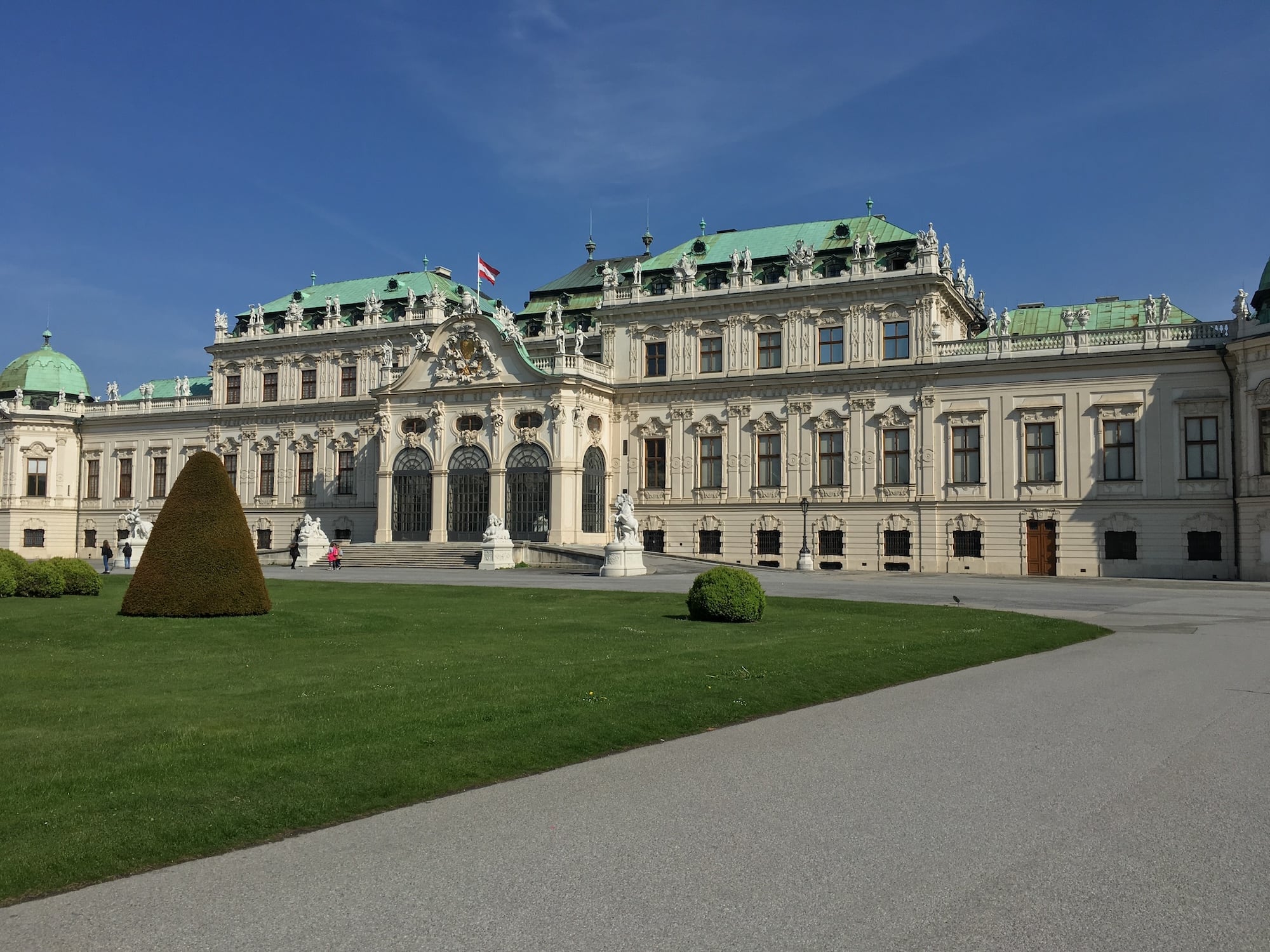
Belvedere (Upper & Lower)
- Time: 1.5–2 hours for the Upper Belvedere
- Open: daily, Upper from 9 am
- Tickets: time slot required
- Where: tram D to Schloss Belvedere
The Kiss hangs here, and nowhere else.
Why go: A Baroque palace with the largest Klimt collection anywhere, plus Schiele, Kokoschka and a good overview of Austrian art from the Middle Ages onwards.
Don’t miss: The view from the upper floor across the gardens to the city. It is the same view Canaletto painted.
Good to know: The Upper Belvedere is the one with Klimt. The Lower Belvedere shows temporary exhibitions and needs a separate ticket, so check what’s on before you buy the combination.
Local tip: If you’re going to the Belvedere mainly for The Kiss, book the 9 am slot and walk straight to the Klimt rooms on the first floor. By 10.30 the tour groups stand three rows deep. Do the quieter side rooms afterwards.
Albertina
- Time: 1.5–2 hours
- Open: daily 10 am–6 pm
- Late: Wednesday and Friday until 9 pm
- Where: behind the State Opera
The easiest museum to fit into a busy day.
Why go: A permanent collection that runs from Monet to Picasso, changing exhibitions that are usually the talk of the season, and the Habsburg staterooms as a bonus.
Don’t miss: The staterooms. Most visitors head straight for the exhibitions and never see them.
Good to know: Dürer’s famous Young Hare belongs to the Albertina but is too fragile to hang permanently. What you normally see is a facsimile; the original only comes out for special exhibitions.

mumok
- Time: about 2 hours
- Closed: Monday
- Open: Tuesday–Sunday 10 am–6 pm
- Where: MuseumsQuartier
The dark basalt cube in the MuseumsQuartier.
Why go: Vienna’s museum for modern and contemporary art: Pop Art, Warhol and Lichtenstein, and the confrontational Viennese Actionism of the 1960s that you won’t see in this depth anywhere else.
Don’t miss: The Actionism rooms, if they are on show. Not for everyone, but it is the most Viennese part of the collection.
Good to know: The whole building changes with each exhibition, so check the programme first. Standard admission is €18.
Leopold Museum
- Time: 2 hours
- Best for: Schiele and Klimt
- Where: MuseumsQuartier, opposite mumok
More Schiele than anywhere else in the world.
Why go: The white limestone counterpart to mumok holds the world’s largest Egon Schiele collection and tells the story of Vienna around 1900 through painting, furniture and design.
Don’t miss: Klimt’s Death and Life, and the Wiener Werkstätte rooms where you see how the same generation designed chairs and cutlery.
Good to know: The Leopold is a private foundation, not a federal museum. The free entry for under-19s that applies at most big museums does not apply here, and the Bundesmuseen Card isn’t valid.
History and imperial Vienna
Two very different ways into the city’s past. One is about a single empress and the court around her, the other about everyone else who ever lived here.
Sisi Museum & Imperial Apartments
- Time: 1–1.5 hours
- Best for: Habsburg court life
- Where: Hofburg, Michaelerplatz entrance
The woman behind the myth, in the palace she tried to avoid.
Why go: The museum takes Empress Elisabeth off her pedestal and shows the restless, private person. The same ticket takes you through the apartments where she and Franz Joseph lived.
Good to know: It is one route through narrow rooms, so it gets tight in the middle of the day. Go at opening time or in the last two hours.
Wien Museum
- Time: 1.5–2 hours
- Price: permanent exhibition free
- Where: Karlsplatz, next to the Karlskirche
The best free hour and a half in the city.
Why go: The city museum reopened in late 2023 after a complete rebuild. The permanent exhibition walks you through Vienna from Roman camp to today, and it costs nothing.
Don’t miss: The central hall, where a ten-metre whale that once hung above a Prater restaurant now floats over the original statues from St. Stephen’s. Then take the lift to the terrace for the view of the Karlskirche.
Good to know: Only the temporary exhibitions on the top floor need a paid ticket.
Museums with kids (and for rainy days)
Both of these are federal museums, which means everyone under 19 gets in free. For more ideas, see our guide to Vienna with kids.
Naturhistorisches Museum
- Time: 2–3 hours
- Closed: Tuesday
- Late: Wednesday until 8 pm
- Where: Maria-Theresien-Platz, facing the KHM
Dinosaurs, meteorites and a 29,500-year-old figurine.
Why go: The mirror image of the Kunsthistorisches across the square, filled with skeletons, minerals and stuffed animals in their original 19th-century cases. Children head for the dinosaur hall, adults end up staring at the meteorites.
Don’t miss: The Venus of Willendorf. She is eleven centimetres tall and has a darkened room to herself.
Good to know: Closed on Tuesdays, when the KHM opposite is open, and open on Mondays, when the KHM is closed. Adults pay €18.
Technisches Museum
- Time: 3 hours, easily more
- Best for: ages 3 to 14
- Where: Mariahilfer Straße 212, near Schönbrunn
The museum where touching things is the point.
Why go: Steam locomotives, aircraft hanging from the ceiling, and floors full of things to push, pull and crank. There are separate play areas for small children.
Good to know: It is a short walk from Schönbrunn Palace. Palace in the morning, museum in the afternoon works well with children who have run out of patience for gilded rooms.
Unusual museums in Vienna
Small, odd, and very Viennese. Both have short opening hours, so plan around them instead of dropping by.
Funeral Museum (Bestattungsmuseum)
- Time: 45–60 minutes
- Open: Wednesday–Friday 10 am–4 pm
- Where: Central Cemetery, Gate 2 (tram 71)
Vienna’s relationship with death, told with a straight face.
Why go: Around 250 objects on how the Viennese bury their dead, from lavish 19th-century hearses to the reusable coffin with a trapdoor that Emperor Joseph II tried to introduce. The city refused.
Don’t miss: The museum shop, which sells its own dark-humoured souvenirs.
Good to know: It is closed at weekends, which is exactly when most people visit the cemetery. Tram 71 takes you there; locals still say “Er fährt mit dem 71er” (he’s taking the 71) when someone has died.
Clock Museum (Uhrenmuseum)
- Time: 45–60 minutes
- Open: Friday–Sunday 10 am–5 pm
- Price: €9, free on the first Sunday of the month
- Where: Schulhof 2, behind Am Hof
More than 700 clocks in one narrow old-town house.
Why go: Three floors of ticking in one of the oldest houses in the centre, from pocket watches to the tower clock mechanism that once ran in St. Stephen’s Cathedral.
Don’t miss: The 18th-century astronomical clock that shows planetary orbits and eclipses.
Good to know: The floors are only connected by spiral staircases. There is no lift, so it isn’t accessible with a wheelchair or pushchair.
Planning: closing days, tickets and free entry
Which Vienna museums are closed on which day?
There is no single closing day in Vienna, and that catches people out. Checked in October 2026:
| Museum | Closed | Late opening |
|---|---|---|
| Kunsthistorisches Museum | Monday | Thursday until 9 pm |
| Upper Belvedere | open daily | none |
| Albertina | open daily | Wednesday and Friday until 9 pm |
| mumok | Monday | none |
| Naturhistorisches Museum | Tuesday | Wednesday until 8 pm |
| Funeral Museum | Saturday to Tuesday | none |
| Clock Museum | Monday to Thursday | none |
In practice: Monday is the day for the Belvedere, the Albertina or the Naturhistorisches. Hours shift around public holidays, so check the museum’s own site for the day you go. Our overview of public holidays in Vienna shows which dates to watch.
Time slots and tickets
Two of the big ones now work with reserved time slots: the Belvedere (Upper and Lower) and, since September 2026, the Kunsthistorisches Museum. Turning up without a booking means waiting for the next free slot, which in high season can be hours away. Book these two a few days ahead and keep the rest of your museum plans loose.
Passes and free entry
- Under 19: free at all federal museums, including the Kunsthistorisches, Belvedere, Albertina, mumok, Naturhistorisches and Technisches Museum. Bring ID for teenagers.
- Bundesmuseen Card (€99): a year of entry to the federal museums and the Austrian National Library. It pays for itself after about five museums, so it suits a longer stay or a return visit within twelve months.
- City passes: worth it only if you plan several paid sights per day. We compare them in Vienna city passes explained.
- First Sunday of the month: free entry at the Wien Museum’s smaller locations, such as the Clock Museum, and at the Museum of Military History.
- Always free: the Wien Museum’s permanent exhibition. More ideas in free things to do in Vienna.
What’s worth combining
Two museums in one day is the limit for most people. After that you stop looking. These pairs work because they are close together and different enough to keep you awake.
- Kunsthistorisches + MuseumsQuartier: old masters in the morning, cross the road, lunch in the MQ courtyard, then mumok or the Leopold.
- Albertina + Hofburg: five minutes apart on foot. Do the Sisi Museum at opening time, the Albertina after lunch.
- Wien Museum + Belvedere: start at Karlsplatz, visit the Karlskirche next door, then walk fifteen minutes up to the Belvedere for an afternoon slot.
- Schönbrunn + Technisches Museum: the family version.
Local tip: Use the late evenings. The Kunsthistorisches on a Thursday after 6 pm or the Albertina on a Friday evening is a different museum: fewer groups, and you can go for dinner straight afterwards. See also what to do in Vienna on a Sunday, when the shops are closed and the museums are not.
Frequently asked questions
Which museum in Vienna should I visit if I only have time for one?
For old masters and architecture, the Kunsthistorisches Museum. For Klimt and The Kiss, the Upper Belvedere. Both need a time slot booked in advance.
Are museums in Vienna closed on Mondays?
Some are, but not all. The Kunsthistorisches Museum and mumok close on Mondays. The Belvedere and the Albertina are open every day, and the Naturhistorisches Museum closes on Tuesdays instead.
Are museums in Vienna free for children?
Visitors under 19 get in free at all federal museums, which includes the Kunsthistorisches, Belvedere, Albertina, mumok, Naturhistorisches and Technisches Museum. Private museums such as the Leopold Museum set their own rules.
Is there a free museum in Vienna?
Yes. The permanent exhibition of the Wien Museum on Karlsplatz is free for everyone, every day it is open. Several smaller city museums are free on the first Sunday of the month.